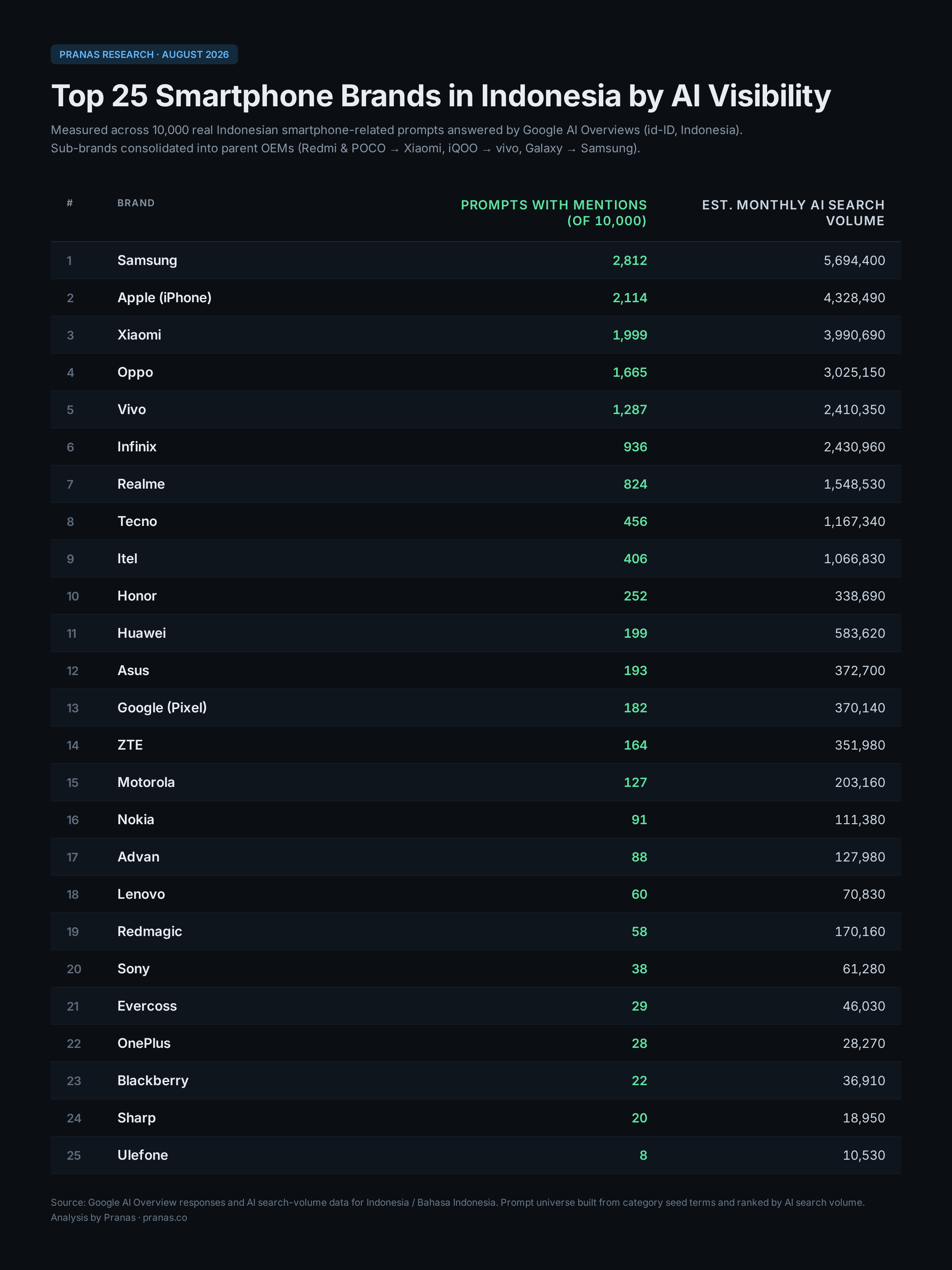
 Top 25 Smartphone Brands in Indonesia by AI Visibility, August 2026 leaderboard
Executive Summary: Who AI Recommends When Indonesians Shop for a Phone
Indonesians increasingly start their phone research inside an AI answer rather than a list of blue links. To find out which brands that answer layer actually favours, we analysed 10,000 real Google AI Overview prompts from the Indonesian market and measured every brand mention inside both the questions and the AI-generated answers.
The top five by AI visibility:
- Samsung — 2,812 prompts (28.1% of the universe)
- Apple (iPhone) — 2,114 prompts (21.1%)
- Xiaomi — 1,999 prompts (20.0%)
- Oppo — 1,665 prompts (16.7%)
- Vivo — 1,287 prompts (12.9%)
Key takeaways:
- Samsung wins the answer layer through content supply, not shipments. Its lead tracks the citability of samsung.com, YouTube reviews and retailer product pages, not unit share.
- Transsion is the hidden number three. Infinix (936) plus Tecno (456) plus Itel (406) equals 1,798 prompts — a combined position ahead of Oppo, driven by dominance of budget-tier prompts.
- AI visibility in Indonesia is a distribution problem. Across all 34 brands measured, the recurring cited domains are YouTube, Blibli, Tokopedia, Erablue, Lazada and Shopee. Owned brand websites are the exception, not the rule.
- Oppo has the weakest earned position among the leaders. Only 57.2% of its mentions are unaided, versus 82.9% for Apple.
Three brands — Samsung, Apple and Xiaomi — account for roughly 69% of all category prompt coverage.
Why AI Visibility Is the New Shelf in Indonesia
In short: the AI answer now shortlists three or four brands before the shopper ever opens a marketplace.
AI visibility is the share of AI-generated answers in which a brand is mentioned. It is becoming the first filter in the purchase journey: before a shopper opens a marketplace or a review site, an AI answer has already narrowed the field to three or four names.
That creates a measurement gap. Shipment trackers tell you what sold last quarter. Traditional rank tracking tells you which URL sits at position three. Neither tells you whether an AI answering "HP 3 jutaan terbaik 2026" will put your brand in its shortlist. If your brand is absent from that shortlist, you are not competing on price or specs — you were never in the consideration set at all.
This study measures exactly that layer for the Indonesian smartphone category, using observed AI answers rather than simulated ones.
The Leaderboard: Top 25 Smartphone Brands in Indonesia by AI Visibility
Samsung, Apple and Xiaomi lead; the drop-off after brand 10 is steep.
| # | Brand | Prompts | Share | Unaided | Est. AI search volume / mo |
|---|---|---|---|---|---|
| 1 | Samsung | 2,812 | 28.12% | 2,011 | 5,694,400 |
| 2 | Apple (iPhone) | 2,114 | 21.14% | 1,752 | 4,328,490 |
| 3 | Xiaomi | 1,999 | 19.99% | 1,488 | 3,990,690 |
| 4 | Oppo | 1,665 | 16.65% | 952 | 3,025,150 |
| 5 | Vivo | 1,287 | 12.87% | 828 | 2,410,350 |
| 6 | Infinix | 936 | 9.36% | 636 | 2,430,960 |
| 7 | Realme | 824 | 8.24% | 587 | 1,548,530 |
| 8 | Tecno | 456 | 4.56% | 339 | 1,167,340 |
| 9 | Itel | 406 | 4.06% | 339 | 1,066,830 |
| 10 | Honor | 252 | 2.52% | 238 | 338,690 |
| 11 | Huawei | 199 | 1.99% | 162 | 583,620 |
| 12 | Asus | 193 | 1.93% | 179 | 372,700 |
| 13 | Google (Pixel) | 182 | 1.82% | 153 | 370,140 |
| 14 | ZTE | 164 | 1.64% | 114 | 351,980 |
| 15 | Motorola | 127 | 1.27% | 113 | 203,160 |
| 16 | Nokia | 91 | 0.91% | 52 | 111,380 |
| 17 | Advan | 88 | 0.88% | 76 | 127,980 |
| 18 | Lenovo | 60 | 0.60% | 55 | 70,830 |
| 19 | Redmagic | 58 | 0.58% | 42 | 170,160 |
| 20 | Sony | 38 | 0.38% | 28 | 61,280 |
| 21 | Evercoss | 29 | 0.29% | 25 | 46,030 |
| 22 | OnePlus | 28 | 0.28% | 26 | 28,270 |
| 23 | Blackberry | 22 | 0.22% | 13 | 36,910 |
| 24 | Sharp | 20 | 0.20% | 17 | 18,950 |
| 25 | Ulefone | 8 | 0.08% | 8 | 10,530 |
How to read this table
- Prompts with mentions — how many of the 10,000 prompts surfaced the brand in the question or the AI answer (counted once per prompt).
- Unaided mentions — the subset where the AI named the brand without the user typing it.
- Est. monthly AI search volume — the summed AI search volume of every prompt where the brand appeared, i.e. the monthly demand the brand is currently visible on.
Nine further brands registered measurable but marginal visibility: Doogee (6 prompts), LG (5), Meizu (4), Nothing (4), Maxtron (4), Fairphone (3), Alcatel (2), CMF (1) and IMO (1).
Methodology: How We Built a 10,000-Prompt Universe
We designed the study so every number is reproducible and every claim traceable to observed AI answers.
Step 1 — Prompt harvesting, not keyword guessing
Rather than scoring invented prompts, we pulled real Indonesian AI Overview question-and-answer pairs using category-neutral seed terms restricted to the question scope: hp, smartphone, ponsel, handphone, hape and android (word match, Bahasa Indonesia, Indonesia location, Google platform). Results were paged at 1,000 rows per request, ordered by AI search volume. Yield: 15,325 unique prompts.
Step 2 — Category hygiene filtering
Indonesian phone data has one large confounder: hp means both "handphone" and HP Inc. We removed:
- HP-the-manufacturer queries (printer, tinta, laserjet, laptop hp, pavilion)
- Other appliance categories (TV, kulkas, mesin cuci, monitor)
- App, game and APK queries
- Telco and data-plan queries (kuota, pulsa, paket data, operator names)
- Accessories (casing, charger, tempered glass, TWS, smartwatch, powerbank)
Survivors: 13,539 prompts.
Step 3 — Universe cap
We ranked survivors by AI search volume and kept the top 10,000. That set is the denominator for every percentage in this study.
Step 4 — Brand detection with parent consolidation
Regex alias sets were applied to both the prompt and the AI Overview answer, with sub-brands folded into their parent OEM: Redmi, POCO and Mi into Xiaomi; iQOO into Vivo; Galaxy, Z Fold and Z Flip into Samsung; iPhone into Apple; Zenfone and ROG Phone into Asus; Nubia into ZTE; Moto and Razr into Motorola; Xperia into Sony; Pixel into Google. Every alias is word-bounded to prevent substring false positives.
Step 5 — Metric definitions
- Prompts with mentions — prompts whose question or answer surfaces the brand, deduplicated per prompt so repeated mentions cannot inflate the count.
- Unaided mentions — the brand appears in the answer but was not named in the prompt. The model chose it.
- Est. monthly AI search volume — the summed AI search volume of prompts where the brand appeared.
- Top cited domains — the domains most frequently cited in answers that mention the brand.
Data sources: AI-search and LLM-mention data for observed AI Overview responses, plus Google Ads search-volume data for demand estimates.
Results Deep-Dive: What Each Column Reveals
Concentration: three brands own roughly 70% of the answer layer
Samsung (28.1%), Apple (21.1%) and Xiaomi (20.0%) together account for about 69% of category prompt coverage. Because a single AI answer typically names three to five brands, that concentration is effectively a default shortlist. For brand 11 and below, the competitive problem is not preference — it is presence.
Unaided share: authority versus name echo
Honor (94.4%) earns its mentions; Oppo (57.2%) largely borrows them from its own brand demand.
Dividing unaided mentions by total mentions separates brands the AI volunteers from brands that only appear because the user typed them.
| Brand | Unaided share | Read |
|---|---|---|
| Honor | 94.4% | Almost every mention is AI-chosen — small footprint, high authority per prompt |
| Itel | 83.5% | Strong earned presence in budget answers |
| Apple | 82.9% | The category's default reference brand |
| Xiaomi | 74.4% | Healthy balance of demand and authority |
| Tecno | 74.3% | Earned budget-tier authority |
| Samsung | 71.5% | Broad footprint plus strong earned share |
| Realme | 71.2% | Solid, mid-tier led |
| Infinix | 67.9% | Volume-heavy, moderately earned |
| Vivo | 64.3% | Above a third of mentions are user-prompted |
| Oppo | 57.2% | The weakest earned share among leaders |
Oppo is the clearest strategic gap in the dataset: 713 of its 1,665 mentions came from prompts where the user already typed "oppo". Its brand demand is doing work its content supply is not. Honor is the inverse — thin coverage, but near-perfect authority when it does appear, which makes coverage expansion the obvious lever.
AI search volume per prompt: not all visibility is equally valuable
Fewer, higher-demand prompts beat many low-demand ones: Itel earns 2,628 volume per prompt, Honor only 1,344.
Dividing estimated AI search volume by prompts with mentions shows how much demand sits behind each prompt a brand appears in.
| Brand | Volume per prompt | Read |
|---|---|---|
| Itel | 2,628 | Concentrated in very high-demand budget prompts |
| Infinix | 2,597 | Fewer prompts than Vivo, comparable demand exposure |
| Tecno | 2,560 | Same high-demand budget cluster |
| Apple | 2,048 | Mass-demand comparison and troubleshooting prompts |
| Samsung | 2,025 | Broad and high-value |
| Xiaomi | 1,996 | Broad and high-value |
| Realme | 1,879 | Mid-market average |
| Vivo | 1,873 | Mid-market average |
| Oppo | 1,817 | Slightly below the mid-market average |
| Honor | 1,344 | Visible mostly in low-demand, niche prompts |
This is why prompt count alone is a misleading scoreboard. Infinix ranks sixth on prompts but its 2,430,960 estimated monthly volume sits above Realme and close to Vivo. Honor is the mirror case: respectable prompt coverage, thin demand behind it.
The Transsion bloc: a hidden number three
Treated as a group, Transsion's Indonesian brands — Infinix, Tecno and Itel — reach 1,798 prompts and roughly 4.66 million in estimated monthly AI search volume. That would place the group third overall and ahead of Oppo.
Infinix + Tecno + Itel = 1,798 prompts — a hidden number three, ahead of Oppo.
It matches Transsion's real strength in the entry tier and its dominance of "HP 1 jutaan / 2 jutaan terbaik" style prompts, where AI answers lean heavily on price-first recommendation lists.
The long tail: what near-zero visibility looks like
Fourteen brands sit below 1% share. Two patterns stand out:
- Legacy recall without AI authority. Blackberry still draws 22 prompts, 9 of them user-prompted — recall persists, relevance does not.
- Zero unaided mentions. Alcatel (2 prompts, 0 unaided) and IMO (1 prompt, 0 unaided) are only ever discussed when the user names them. In AI-answer terms, they are effectively invisible.
- Premium niche brands survive on specialists. Redmagic, OnePlus, Nothing and CMF appear almost exclusively through enthusiast and global review domains rather than Indonesian retail — visible to researchers, absent from mainstream buying prompts.
Top Cited Domains: Where Indonesian AI Answers Get Their Evidence
Video and marketplaces, not brand websites, supply the evidence AI cites.
Every brand row carries the five domains most cited in answers that mention it. Counting how many of the 34 brands each domain appears for exposes the true citation infrastructure of the Indonesian smartphone category.
| Cited domain | Appears in top-5 sets for | Type |
|---|---|---|
| youtube.com | 31 brands | Video / creator |
| blibli.com | 23 brands | Marketplace |
| tokopedia.com | 23 brands | Marketplace |
| erablue.id | 15 brands | Electronics retailer |
| instagram.com | 9 brands | Social |
| lazada.co.id | 8 brands | Marketplace |
| shopee.co.id | 6 brands | Marketplace |
| erafone.com | 5 brands | Phone retailer |
| google.com | 5 brands | Google surfaces |
| support.google.com | 3 brands | Support documentation |
| tiktok.com | 3 brands | Social video |
| dorangadget.com | 3 brands | Gadget specialist |
| 91mobiles.com | 3 brands | Global spec database |
Observation 1: Video is the single largest citation surface
YouTube is cited for 31 of the 34 brands measured — more than any retailer, publisher or brand site.
Indonesian AI answers about phones are substantially built on video review content: unboxings, camera comparisons, price-tier roundups and repair walkthroughs. A brand with no credible Indonesian-language video review layer is missing the most frequently cited evidence type in its category.
Observation 2: Marketplaces are the de facto product database
Blibli and Tokopedia each appear for 23 brands, with Erablue at 15, Lazada at 8, Shopee at 6 and Erafone at 5. AI answers pull price, variant, storage and availability facts from product detail pages. That makes marketplace listing hygiene — accurate titles, complete specification tables, correct variant naming, current pricing — a direct AI-visibility input, not a channel-team detail.
Observation 3: Owned brand sites are the exception
Only eight of 34 brands see their own domain in their top-five cited set: samsung.com, mi.co.id, vivo.com, realme.com, honor.com, consumer.huawei.com, lenovo.com and meizu.com. Even for market leaders the owned site is usually the fourth or fifth citation, behind YouTube and retail. Notably, Apple's own domain does not appear in its Indonesian top five at all — its visibility is carried entirely by third parties.
The implication is uncomfortable but clear: in this category, publishing more owned content is a weaker lever than becoming better represented on the surfaces AI already trusts.
Observation 4: Social content is quoted as evidence
Instagram appears for 9 brands and TikTok for 3. These citations cluster around troubleshooting, price-check and authenticity prompts, where creator and seller posts are the only current source. It confirms that user-generated content is not merely awareness media in Indonesia — it is quotable evidence inside AI answers.
Observation 5: Specialist review sites carry the premium and gaming tail
Independent specialists punch far above their traffic weight in the long tail: dorangadget.com (Tecno, Redmagic, OnePlus), carisinyal.com (Nothing, Alcatel), 91mobiles.com (Redmagic, OnePlus, Ulefone), and GSMArena, PCMag, TechAdvisor and CNET for CMF. For challenger and enthusiast brands, a handful of specialist reviews is the cheapest realistic path into the answer layer.
Observation 6: Support and platform domains signal a troubleshooting prompt cluster
support.google.com and developer.android.com surface for Apple, Motorola, Lenovo and Google. These come from "how do I…" and "why won't my phone…" prompts. That cluster is high-volume, low-competition and almost never owned by the phone brand itself — a genuine open opportunity for whoever publishes clear Indonesian-language support content.
What This Means for Brand and Marketing Teams
Five actions, in priority order.
- Treat retailer product pages as AI infrastructure. Audit titles, spec tables, variant naming and pricing on Blibli, Tokopedia, Erablue, Lazada, Shopee and Erafone. These pages are cited more often than your website.
- Build a deliberate Indonesian video layer. Ensure every price tier you compete in has current, credible Bahasa Indonesia review and comparison video coverage.
- Pursue specialist review coverage, not just mass media. A single gadget-specialist review can put a challenger brand into answers where paid media cannot reach.
- Monitor unaided mentions, not total mentions. If most of your mentions come from prompts that already name you, your visibility depends on existing demand and will not compound.
- Target price-tier and troubleshooting prompts explicitly. These are the highest-volume, most under-owned prompt clusters in the Indonesian category.
Credibility Controls and Limitations
Controls in place:
- Prompts and answers are observed AI Overview responses, not simulated, each carrying first and last response timestamps.
- Every metric is computed from raw rows, so all figures are reproducible from the harvested universe plus the alias table.
- Prompt-level deduplication prevents repeated-mention inflation.
- Alias sets are word-bounded and parent-consolidated, and a category hygiene filter removes the hp ambiguity that distorts most Indonesian datasets.
- Directional sanity check: the leading cluster (Samsung, Oppo, Xiaomi, Vivo, Transsion) matches the brands consistently reported as Indonesia's top vendors by shipment trackers.
Limitations to read alongside the results:
- Google AI Overview only. ChatGPT mention data is US and English-only upstream, so no ChatGPT column exists for Indonesia.
- Volume-ranked universe. Very long-tail, low-volume prompts are under-represented by design.
- Regex detection limits. Ambiguous brand mentions inside quoted source titles cannot be fully resolved.
- Volume is an estimate. AI search volume is derived from search demand, not a measured impression count.
- Apple's placement is an AI artefact. Its second place reflects reference-brand effects in comparison and troubleshooting prompts, not Indonesian shipment share. This is the study's most important interpretive caveat.
Frequently Asked Questions
Want this analysis for your own brand and market? Pranas measures AI visibility, coverage and mention rate across leading AI models, and shows exactly which sources they cite. Start tracking your AI visibility or read our guide to generative engine optimization.